Abe by David S. Reynolds
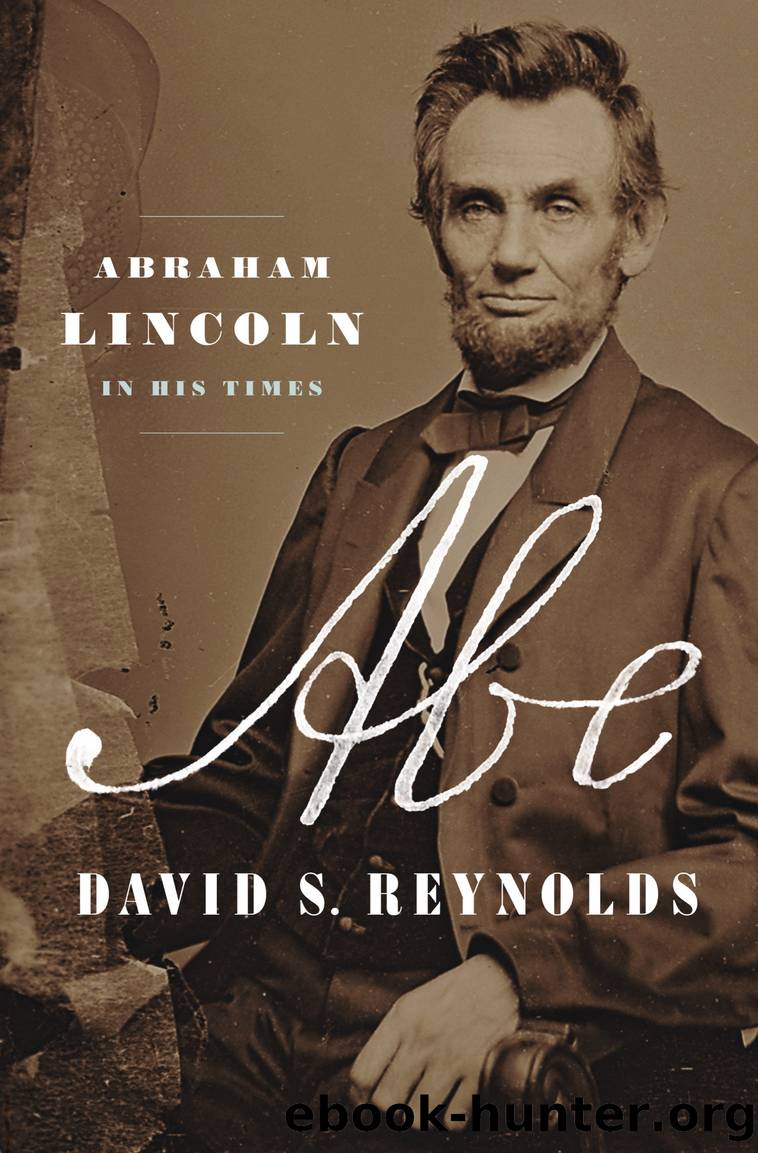
Author:David S. Reynolds [Reynolds, David S.]
Language: eng
Format: epub
Publisher: Penguin Publishing Group
Published: 2020-09-29T00:00:00+00:00
A Pook Turtle
A fleet of seven innovative gunboats was being built for the Unionâs river campaign. Designed by the famous St. Louis engineer James B. Eads, the slope-sided boats were called mud turtles or Pook Turtles (after Samuel Pook, the contractor who built them). Flat-bottomed paddle wheelers, the boats were formidable. Each was 175 feet long and 51 feet wide and carried thirteen large-caliber guns. Four of the boats were the first ironclads built in the United States; the other three were of wood.
The problem, as Anne Carroll saw it, was advancing down the heavily fortified Mississippi River from St. Louis. In November 1861, she traveled to Missouri, stopping along the way to meet with Union troops and generals, including Ulysses S. Grant and William Tecumseh Sherman. In St. Louis, while staying at the Everett House, she studied topographical maps and concluded that descending the Mississippi was inadvisable, because the river was shallow in some places and its current ran south. The heavy Pook Turtles were slow and could not move backward against a current. If crippled by enemy fire, they would float helplessly back into Confederate-held areas.
Anne thought about an alternate route of attack. She focused on the 652-mile Tennessee River, which flows from east Tennessee through Chattanooga and northern Alabama before running up through Tennessee and Kentucky, where it joins the Ohio River. She interrogated the pilot Charles M. Scott about the Tennessee River. A Southerner who had left the Confederacy and joined Brigadier General Grant as a pilot, Scott told her that he had often navigated the river and knew it to be of sufficient depth for the Pook Turtles. Anne decided that the Union force should not approach the rebel forts directly, on the Mississippi, but from the less-protected rear, by going up the Tennessee River and, where necessary, proceeding overland. This strategy would also allow for cutting the Memphis and Charleston Railroad, a main Confederate supply route. Anne envisaged a rapid move on to Vicksburg, the rebelsâ major stronghold on the Mississippi, and a simultaneous attack on Mobile, Alabama, via the Gulf of Mexico, followed by moving north through Alabama on the Tombigbee and Alabama Rivers.
On November 12, Anne wrote about her plan to Attorney General Bates and Assistant Secretary of War Thomas A. Scott. She also sent a note to Lincoln. Soon she was back in Washington, where she composed a concise but comprehensive summary of the plan. âThe civil and military authorities,â she wrote, âseem to be laboring under a great mistake in regard to the true key of the war in the Southwest. . . . Now all preparations in the West predicate that the Mississippi River is the point to which the authorities are directing their attention. . . . The Tennessee offers many advantages over the Mississippi.â31
She described these advantages so persuasively that the Ohio senator Benjamin Wade, a Radical Republican who headed a congressional committee on the war, took her summary immediately to Lincoln. The president was diffident.
Download
This site does not store any files on its server. We only index and link to content provided by other sites. Please contact the content providers to delete copyright contents if any and email us, we'll remove relevant links or contents immediately.
| Africa | Americas |
| Arctic & Antarctica | Asia |
| Australia & Oceania | Europe |
| Middle East | Russia |
| United States | World |
| Ancient Civilizations | Military |
| Historical Study & Educational Resources |
The Dawn of Everything by David Graeber & David Wengrow(1717)
The Bomber Mafia by Malcolm Gladwell(1633)
Facing the Mountain by Daniel James Brown(1563)
Submerged Prehistory by Benjamin Jonathan; & Clive Bonsall & Catriona Pickard & Anders Fischer(1461)
Wandering in Strange Lands by Morgan Jerkins(1436)
Tip Top by Bill James(1420)
Driving While Brown: Sheriff Joe Arpaio Versus the Latino Resistance by Terry Greene Sterling & Jude Joffe-Block(1380)
Red Roulette : An Insider's Story of Wealth, Power, Corruption, and Vengeance in Today's China (9781982156176) by Shum Desmond(1365)
Evil Geniuses: The Unmaking of America: A Recent History by Kurt Andersen(1359)
The Way of Fire and Ice: The Living Tradition of Norse Paganism by Ryan Smith(1342)
American Kompromat by Craig Unger(1327)
F*cking History by The Captain(1312)
It Was All a Lie by Stuart Stevens;(1308)
American Dreams by Unknown(1294)
Treasure Islands: Tax Havens and the Men who Stole the World by Nicholas Shaxson(1279)
Evil Geniuses by Kurt Andersen(1262)
White House Inc. by Dan Alexander(1219)
The First Conspiracy by Brad Meltzer & Josh Mensch(1180)
The Fifteen Biggest Lies about the Economy: And Everything Else the Right Doesn't Want You to Know about Taxes, Jobs, and Corporate America by Joshua Holland(1128)
